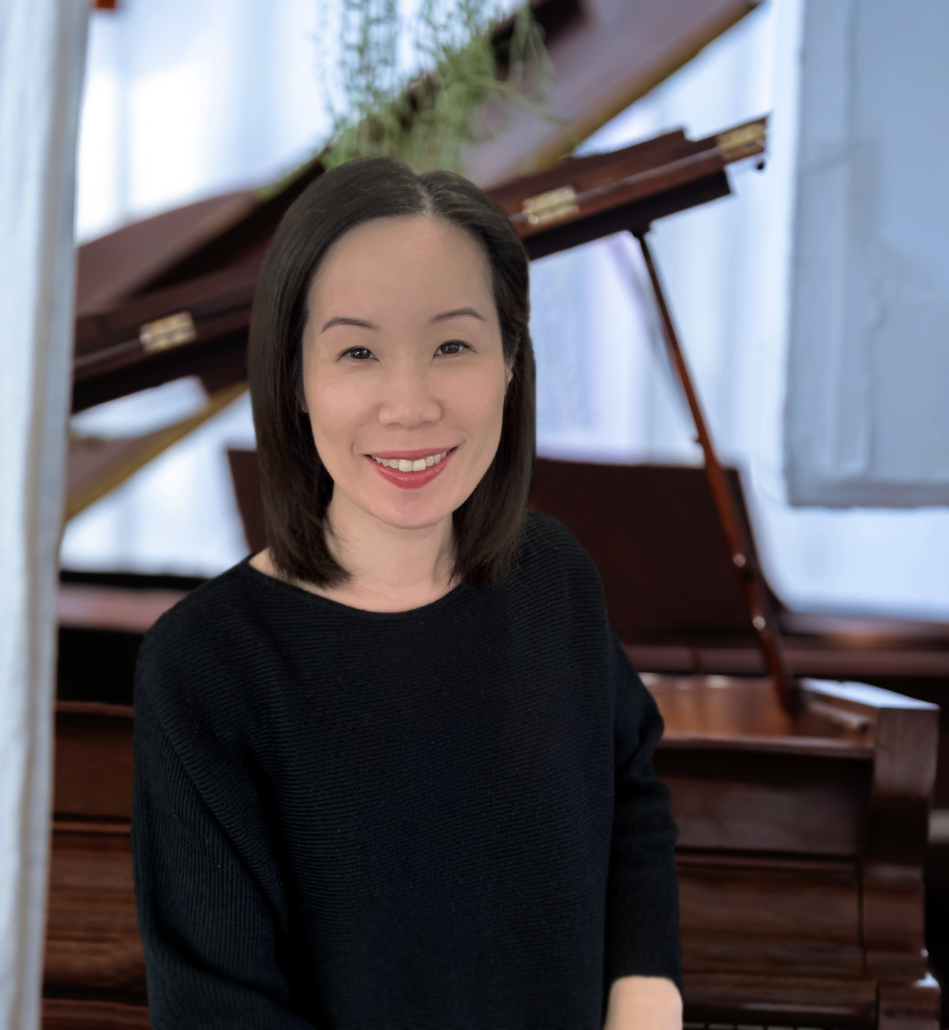
My name is Winnie, an Oxford music graduate and former pianist of the Hong Kong Philharmonic Orchestra. In 2017, my son was diagnosed with Level 2 Autism and ADHD. Inspired by Music Therapy’s transformative impact on my son and myself as a carer, I retrained as a Registered Music Therapist (RMT) and Neurologic Music Therapist (NMT) when he started primary school.
As both the carer of an NDIS participant and an RMT, I’m writing to urge the NDIS to reinstate Music Therapy funding under the Capacity Building – Improved Daily Living category at rates consistent with other Allied Health professionals. Here is our family’s experience to support the significant benefits of Music Therapy.
Our Journey: From Struggles to Hope
My son, born with 16p11.2 microdeletion, struggled with verbal expression, group activities, and sensory challenges. Traditional therapies like speech and occupational therapy brought valuable and functional progress, and we are grateful for their support. At the same time, the commitment to consistent practice at home was significant and, at times, left us feeling mentally stretched as parents.
Music therapy offered a different kind of breakthrough, creating a space where he was celebrated for his strengths and gifts rather than defined by his challenges, while also supporting his goals and the generalisation of skills learned across other therapies through a person-centred, creative approach. Through music, he explored freely and developed motor and social skills, giving us glimpses of his true personality and real potential that were often overlooked – yet so important for both our child’s and our own mental health and outlook on life.
Music eventually became a source of motivation for our family, helping us continue our special needs journey with creativity, perseverance, and renewed hope.
Music Therapy at Home: Our Family’s Journey
As I trained as a Music Therapist, I integrated its techniques into daily life, helping my son overcome challenges. Responding to Bill Shorten’s request, I’ll share specific examples of functional outcomes achieved through Music Therapy in our family’s journey.
1. Cognition & Thinking
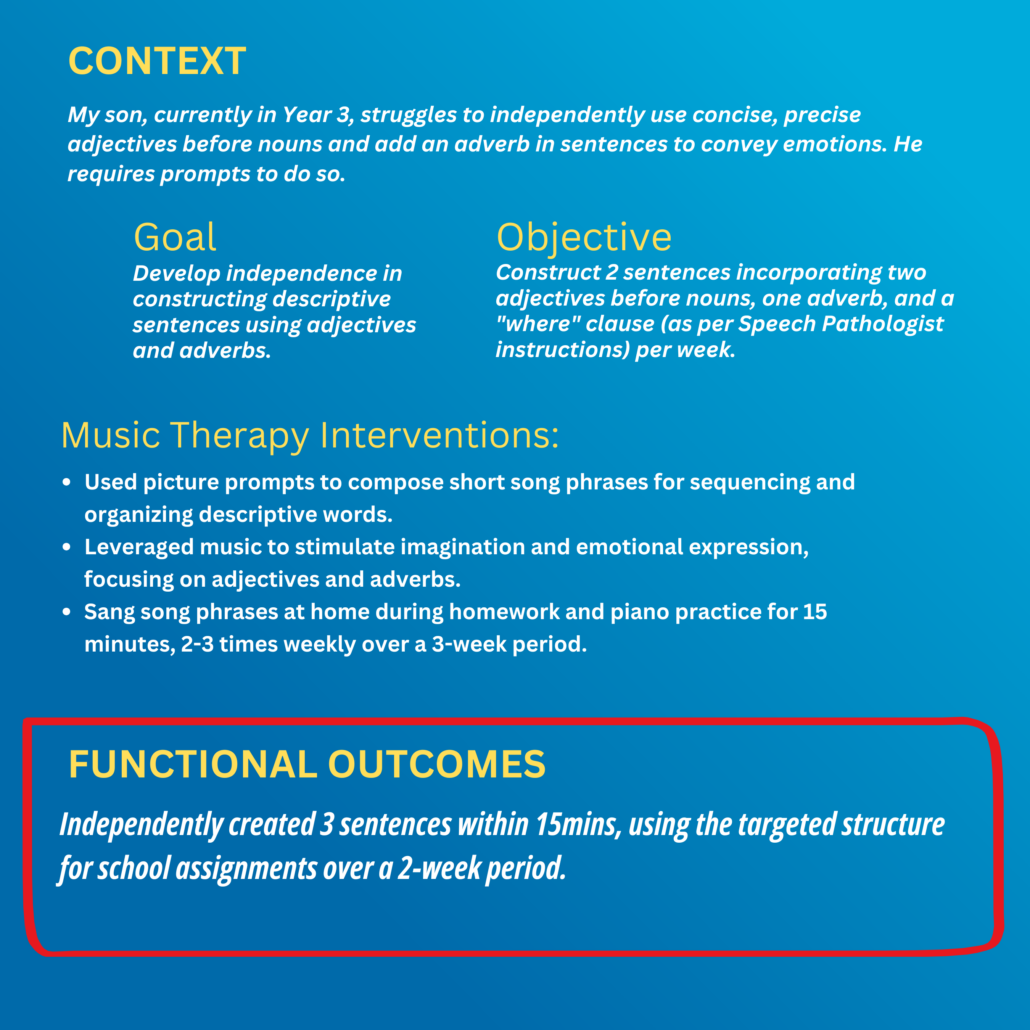
2. Communication & Social Interaction
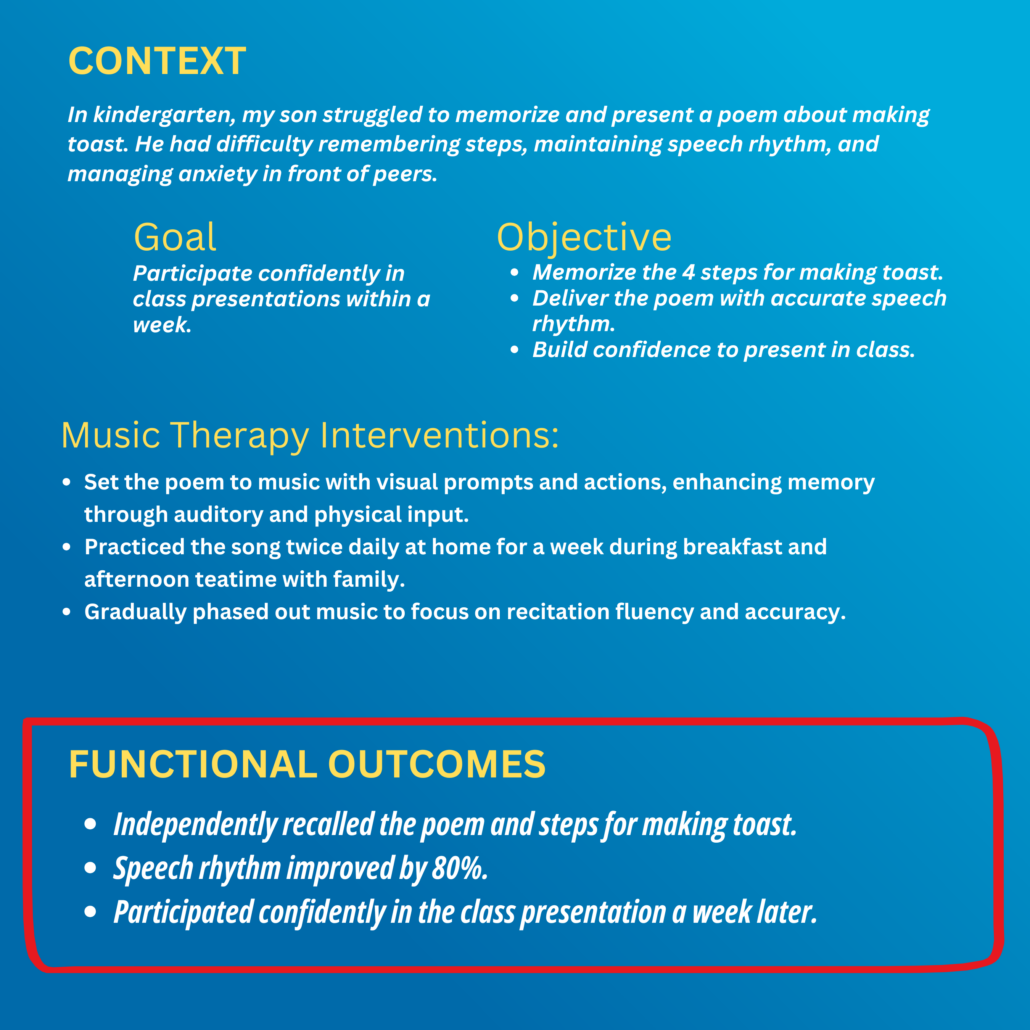
3. Mobility & Coordination
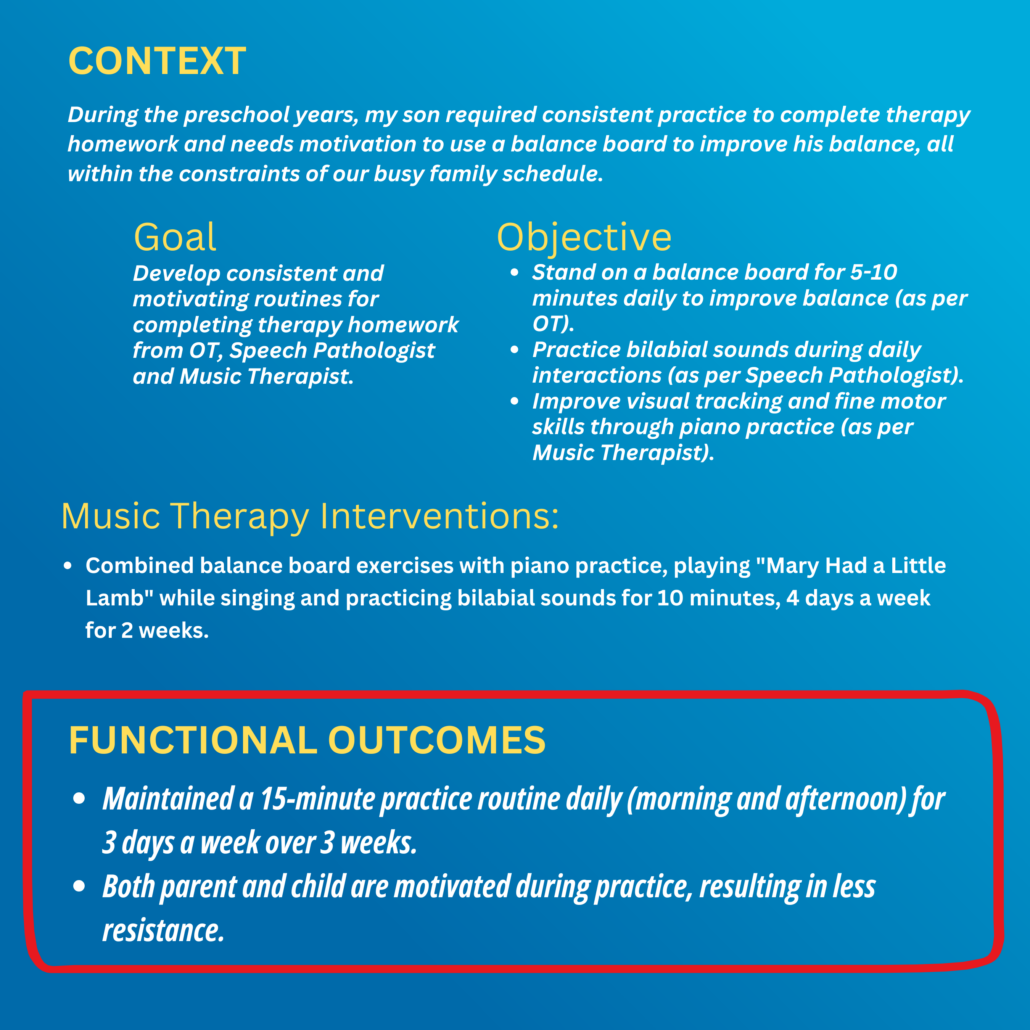
4. Behaviour & Self-Regulation
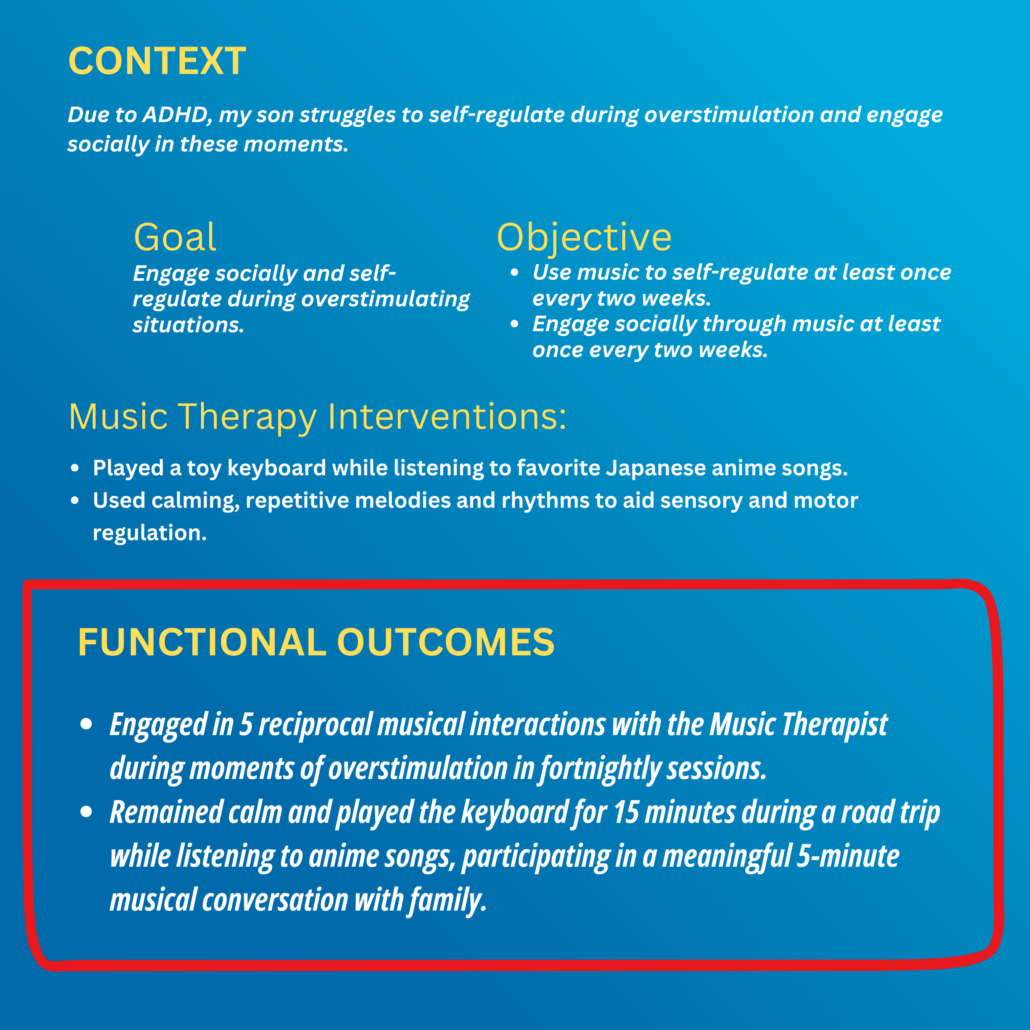
Other Benefits of Music Therapy Beyond Functional Outcomes
Beyond the functional outcomes, Music Therapy became a bridge connecting my son with our family. It allowed us to celebrate belonging and include him meaningfully, despite his challenges. Over time, he achieved milestones we once thought impossible: participating in school concerts, band performances, and even Eisteddfod competitions this year! Music Therapy is more than a therapeutic tool—it fosters relationships, builds friendships, and cultivates a sense of achievement, crucial for children’s mental health and self-esteem as they grow.
Becoming an RMT: Paying It Forward
As a Registered Music Therapist, I now support other families, collaborating with speech pathologists, occupational therapists, and educators to create engaging opportunities for children to practice and generalize their skills. Music Therapy doesn’t duplicate other therapies—it enhances them, offering motivation, joy, and hope to families navigating challenges.
Music Therapy does more than teach families to survive adversity; it empowers them to thrive, fostering resilience, purpose, and belonging in ways traditional therapies often cannot.
A Call for Continued Inclusion in the NDIS
As both a parent and professional, I’ve seen the profound impact of Music Therapy on families. The recent funding cuts by the NDIS undermine the value of highly qualified Registered Music Therapists. Expecting services at unsustainable rates risks denying families access to life-changing benefits or forcing them to settle for unqualified providers, which is not in participants’ best interests. I urge the NDIS to reverse their decision and reinstate Music Therapy as a funded support under Capacity Building – Improved Daily Living at rates aligned with other Allied Health professionals.
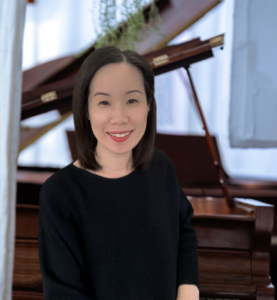
RMT, NMT, MCMT, MA(Oxon), BA(Hons)Mus (Oxon), LRSM, CTABRSM